
When I was in college, I read books on topics like information technology and history. By reading these books, I saw the following pattern: Data → Information → Knowledge → Insights → Wisdom.
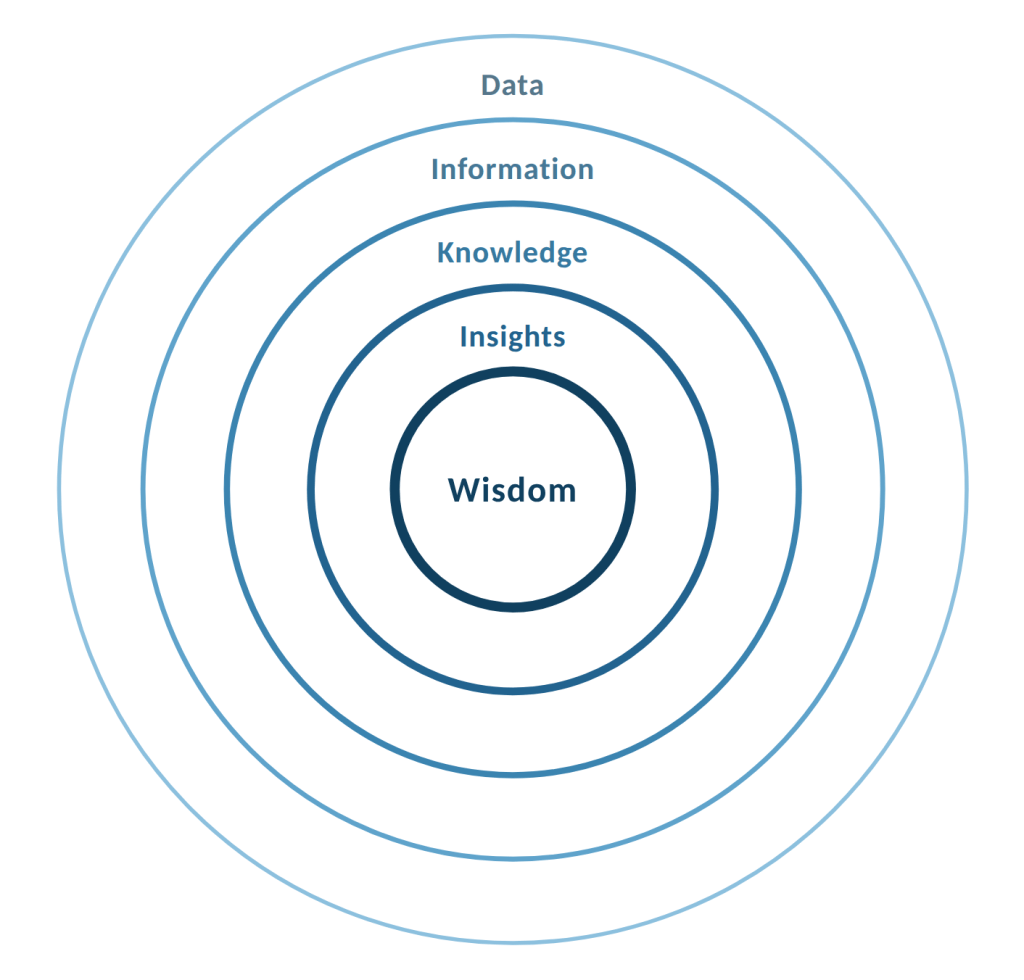
I thought the latter is a subset of the former. The whole picture can be visualized as a set of concentric circles, converging into the smaller center.
A logical conclusion then appeared to me as follows: With more data, we become wiser. More data, more wisdom.
Thanks to the invention of the internet and the emergence of AI, we now consume more data than we ever have. We are constantly in front of a screen (or multiple screens), consuming text, audio, and video. When was the last time you sat on a subway and did not see the whole car of passengers all glued to their phones?
But, do people who consume the most amount of data become the most wise? The people who consume the most data are probably the ones glued to their phones all day long, watching TikTok videos. Are they “wise”?
If we are becoming wiser collectively (because we all consume more data these days), retail investors would waste less money on zero-days-to-expiration options, consumers would eat less deep-fried food, and we would all make better choices for ourselves and execute these decisions with more discipline. I think you all agree with me—on a collective scale, that is not what we are seeing.
Therefore, I have increasingly come to think that, from data to wisdom, in that chain of relationships, the latter is not just a subset of the former. At each step, and especially toward the end, something bigger, outside, extra, comes into play.
For example, a person’s culture can come into play, influencing how he or she interprets information (Information → Knowledge). Look at impoverishment and the range of resulting behaviors. In some cultures, in order to get out of poverty, people save money aggressively. That’s what they know, their knowledge. In some other cultures, lacking money leads to another kind of behavior: people immediately spend all the money they have. The more they spend, the safer they feel. In their world, it is just “what you do.” That is their knowledge.
For another example, when it comes to wisdom, what is wise in one culture can be seen as unwise in another culture. Often, people cannot agree on what wisdom is, who wise people are. I discussed this topic in my prior essay Types of Wisdoms (link).
If this logic holds, the relationship from data to wisdom should actually look like the following:
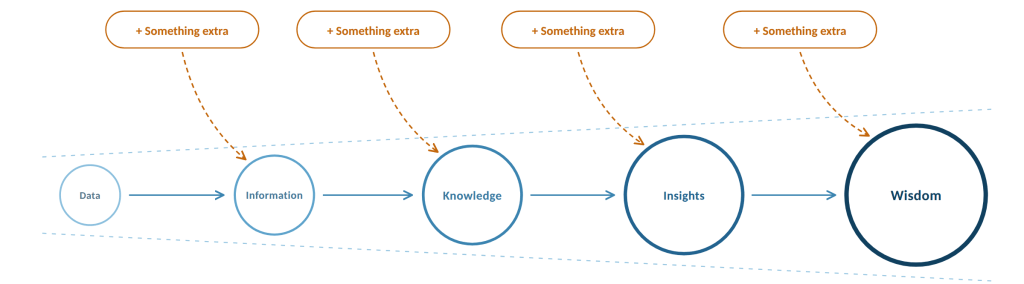
At each step, “something extra” comes in—instead of merely more of the same homogeneous data. It could be one’s cultural background, one’s upbringing, one’s cross-domain expertise, etc.
The origin of this “something extra” probably has something to do with the bigger reality in which one lives: unconventional backgrounds, unusual conditions, unique life experiences. The “bigger” one’s reality is, the more “something extra” one has. Cumulated “something extra” allows the person to enjoy a higher chance of transcending onto the next level, instead of converging to sameness.
Think about the greatest figures in history, across a variety of fields—philosophy, art, military, etc. Many of them have unique backgrounds. It can be something “inner.” A lot of struggles earlier in their lives—those experiences, especially traumatic ones, shaped these figures before they became who they are.
It can be something “outer.” They were born in the right place, at the right time. And what unfolded later in that place gave them an abundance of “something extra”: They got to live through or even participate in historical events; they met or befriended unique figures in human histories and learned directly from them.
If this idea is true, it has material implications. For the AI movement, with more data and more compute, we still may not get to an AI that is truly “wise.” AI already knows more data than any one of us will ever know, but wisdom is something different. “Something extra” than just data and compute.
There are also implications for investing as well. The conventional idea of how most people (even professional capital allocators) define a good investor is that he or she goes to the right school (typically an Ivy League), picks the right major (typically economics and or finance), works at the right company (a bank and or an investment institution), and accumulates enough years of experience, so that person can invest on his or her own.
If the framework I proposed above holds, these conventional criteria are turned on their heads: Candidates with these backgrounds are the least desirable, because the input they have in their lives are too narrow to allow them to think differently, act differently. They see what other people see. They come to the same knowledge, the same insight, and the same wisdom. Their lives are narrow. Their reality is small. They converge.
Instead, for successful investing, we should look for candidates with more diverse elements under their belt. For example, unique early life experiences, and multi-disciplinary experiences that have little to do with investing. Many successful investors seem to have some forms of traumatic early-life experiences (that shape them early on). Many also have a background or a deep interest outside of finance, such as history study (that gives them additional view points). It is those “something extra” elements, not majoring in finance and working at some investment institutions, that imbue an investor with the right temperament, allowing them to interpret things differently so they might have a chance in successful investing.
Almost a millennium ago, shortly before he passed away, legendary Chinese poet Lu You reflected on his decades of poem writing. He lived through political instabilities and fought on the frontline of war. He wrote to his children, “The real work lies outside the poem” (工夫在诗外).
So, from data to wisdom, we need a bigger reality.
(END)

